Dundas Square: More Lies Revealed
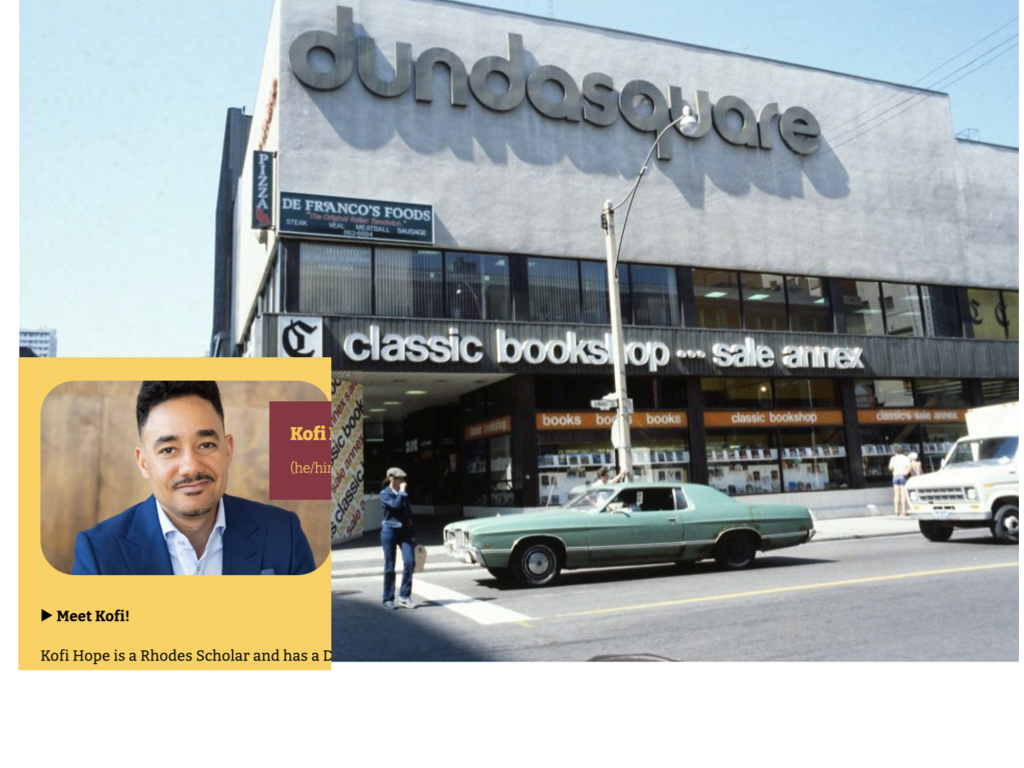
The City of Toronto paid a lot of money to rename Dundas Square, and a significant chunk went to Kofi Hope and his design firm Monumental Projects. Dr. Hope is an expert in naming public infrastructure and he has a special distaste for British Imperialists like Henry Dundas. At least that's what he wants us to believe. You see, when it suits his interest, Dr. Hope will happily preserve and publicizie the name of other British imperliasts, in spite of their troubled legacy.
Kofi Hope doesn’t want Henry Dundas’ name to be remembered in Toronto. But Kofi Hope likes to remind everyone that he’s a Rhodes Scholar.
This might not seem like a contradiction but it is. This is the selfishness of Kofi Hope.
Dr. Hope is a Rhodes scholar. He wants you to know that. On every one of his online biographies, of which there are many, the first sentence is always the same. “Kofi Hope is a Rhodes Scholar.” This makes Dr. Hope sound smart.
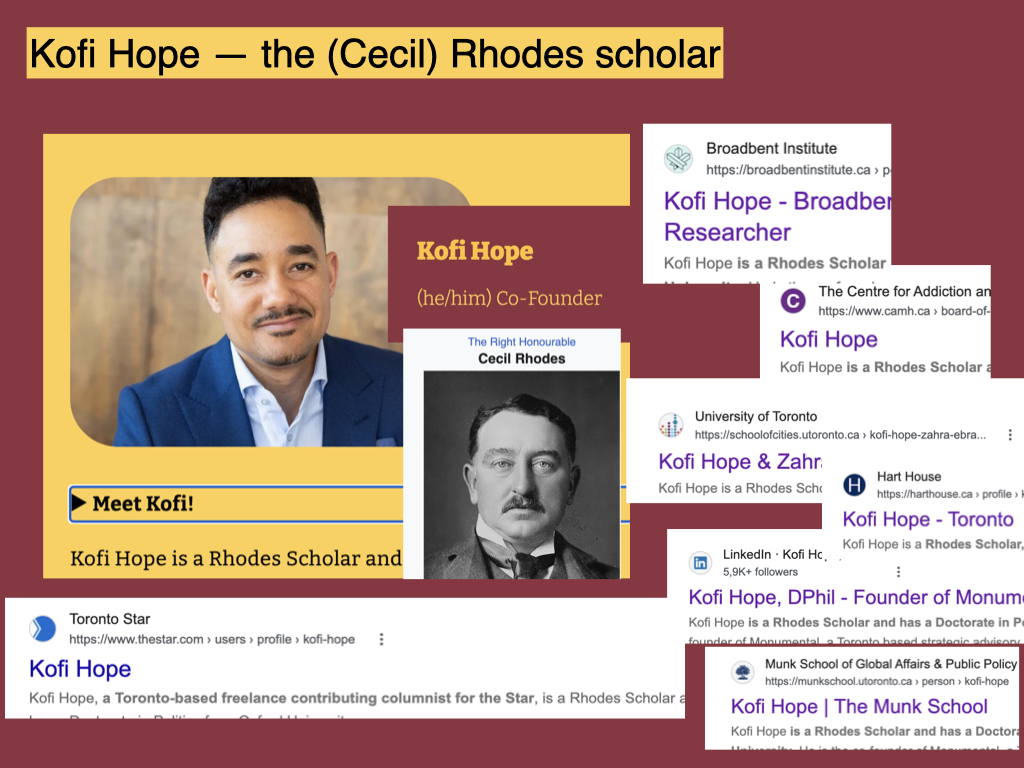
Dr. Hope was also one of the key persons involved in the City of Toronto’s decision to change the name of Dundas Square. He is an expert on naming public infrastructure and he believes Henry Dundas’ name should be erased from Toronto history. Dr. Hope has a special dislike for British colonialists.
Why does Dr. Hope believe Henry Dundas’ name should be erased from Toronto’s history but still proudly mention Cecil Rhodes’ name in his own online biographies?
There is a contradiction here, which can only be explained by Dr. Hope’s financial self-interest and need for public acclaim.
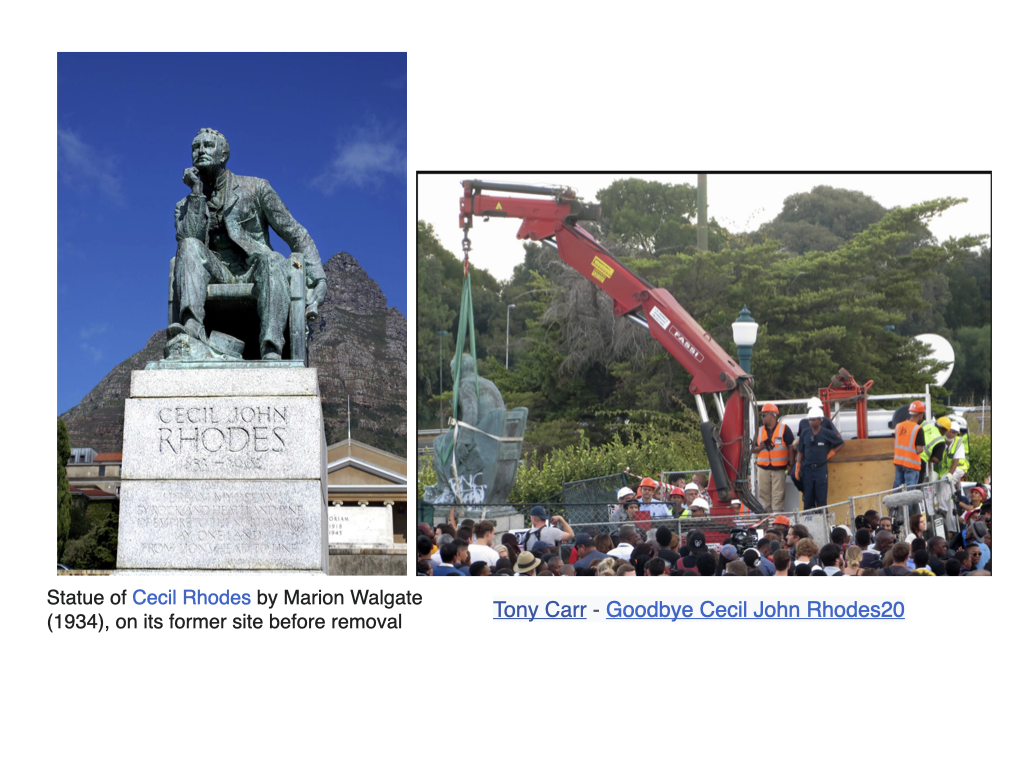
Cecil Rhodes was an awful person by today’s standards. Since the early 1950s, memorials to Cecil Rhodes have been opposed in South Africa. In 2015, a #RhodesMustFall movement started to get the statue of Cecil Rhodes removed from the University of Cape Town. In spite of all these movements against Cecil Rhodes, and all the documentation about Cecil Rhodes’ life and racist policies, Dr. Hope still likes to tell everyone in his online biographies that he’s a Rhodes Scholar. This helps Dr. Hope get contracts from the City of Toronto. It also makes Dr. Hope feel smarter than his colleagues.
The Rhodes scholarship is the most prestigious academic scholarship in the world. It undoubtedly helped Dr. Hope get where he is today, and it’s still opening doors and helping him get contracts from the City of Toronto and Toronto Police. That’s one reason why Dr. Hope keeps Cecil Rhodes mentioned in the first sentence of all his online biographies.
If Dr. Hope really believed it’s necessary to tone down our reverence for British colonialists, he’d probably remove that sentence about Rhodes from his online biography. But Dr. Hope keeps it. He doesn't just mention the Rhodes scholarship. It's the first sentence in each online bio. Cecil Rhodes helps Dr. Hope, so he keeps his name in the first sentence of his online biography. Removing Henry Dundas’s name from public infrastructure also helps Dr. Hope, so he advises everyone it’s in the public interest to do so.
The common denominator here is: whether a name stays or goes depends on Dr. Hope’s personal interest. This isn't science. It's selfishness.
Dr. Hope doesn’t really believe that the name Henry Dundas should be removed from Toronto infrastructure. It’s just a story he’s telling to earn money with his Ph.D. His willingness to promote his Rhodes scholarship in his online biography gives a more accurate picture of what Dr. Hope’s thoughts on British imperialism are.
Maybe we can make a deal with Dr. Hope. Let Toronto keep the name Dundas Square and Dr. Hope can keep Dr. Rhodes's name in his online bio.
About Cecil Rhodes (from Wikipedia)
The son of a vicar, Rhodes was born in Netteswell House, Bishop's Stortford, Hertfordshire. At seventeen his family sent him to South Africa in the hopes the climate might improve his poor health. At eighteen, he entered the diamond trade at Kimberley in 1871 and with funding from Rothschild & Co, began to systematically buy out and consolidate diamond mines. Over the next two decades, he gained a near-complete monopoly of the world diamond market. In 1888, he founded the diamond company De Beers, which retains its prominence into the 21st century.
Rhodes entered the Cape Parliament at the age of 27 in 1881,[3] and in 1890, he became prime minister. As prime minister, he took (through eminent domain) land from black Africans with the Glen Grey Act, while also tripling the wealth requirement for voting under the Franchise and Ballot Act, effectively barring black people from taking part in elections.
Rhodes wanted to expand the British Empire because he believed that the Anglo-Saxon race was destined for greatness. In what he described as "a draft of some of my ideas" written in 1877 while a student at Oxford, Rhodes said of the English, "I contend that we are the first race in the world, and that the more of the world we inhabit the better it is for the human race. I contend that every acre added to our territory means the birth of more of the English race who otherwise would not be brought into existence."